Curveballs

By | Blog

We are both big baseball fans. The Twins and the Cubs are our favorite teams and we are more than a little heartbroken that they both had early exits from this year’s playoffs (though given that the Cubs won the World Series in 2016 and then Trump won, maybe their early loss this year is a good thing?) 

Dan’s dad was a HUGE baseball fan. He often used to say that baseball is a great analogy for many parts of real life. That observation has felt especially relevant to both of us recently. 

They say that the hardest act in all sports is hitting a baseball. It’s hard to prepare yourself for the different pitches because you never know what’s coming. Fastballs are probably the easiest to hit but then there is that damned curveball.

We’ve been talking about curveballs a lot lately. It seems like each time we feel that we are beginning to settle into a groove with this whole Metastatic Breast Cancer thing (learning to hit the fastballs) along comes some new crazy curveball.

The latest unexpected curve doesn’t even have anything to do with Cassie’s cancer. About a year ago, she began to experience bad pain in her back. After ruling out further cancer metastasis, it was diagnosed as a herniated thoracic disc. While it’s pretty uncommon to have a bad disc in that region of the back the doctors still thought it would cure itself as do most similar injuries.

Well it didn’t. The pain has only gotten worse and after a number of further consultations, and a second opinion at the Mayo Clinic, the recommended course of action is surgery. Yes, even surgery for someone with Metastatic Breast Cancer. It’s suggested because the risks of NOT having the surgery are potentially severe including what the doctors termed “a real possibility of paralysis” if we don’t act. 

And of course it’s not just any surgery. It will be a complicated procedure likely necessitating multiple days in the hospital and a long and hard recovery. So once again we feel like we have been hit by a truck, or rather to torture the baseball analogy, like we have been hit in the head by an errant curveball. We are worried and frightened. We feel isolated (thanks Covid) and overwhelmed. We keep saying “enough already” and it’s “too much” but then one of us always says — “yeah but it doesn’t get to be too much” and we just have to deal.

So that’s what we are trying to do. Even though, like almost everybody else in the midst of this pandemic and election season, we are exhausted and depleted. We don’t get to pick and choose the curveballs that come at us, we only get to decide how we react to them. To us that means remembering that every day we get to make a choice between hope and despair. Most days we choose hope and we move forward. And on the days that we can’t choose hope, where it all just feels too overwhelming, well on those days we remember that we get to make the same choice all over again the next day.

This latest curveball sucks. The surgery is going to suck and the recovery will probably suck as well. But all that said, we choose hope because that’s the only bat that will allow us to hit this curveball and the next. And who knows, a little more hope may even get the Twins and Cubs back to the World Series one of these days. 
No Insignificant Birthdays

By | Blog

My birthday was last weekend. On a birthday morning walk with a close friend, I found myself saying: “It’s just 53 not at all a significant birthday.” Then I almost immediately contradicted myself by adding: “But if we have learned anything recently it’s that there is no such thing as an insignificant birthday.” 

There is no such thing as an insignificant birthday. So simple but also a new mental frame. Who cares if the birthday doesn’t end in a zero or five? Every year we have is special and worth celebrating just because we have it. For me and Cassie, every birthday is a now poignant reminder that we are each still alive and choosing  to live our lives as fully and full of love as we can.

Early on, after Cassie’s Metastatic Breast Cancer diagnosis, a number of people said something that I found strange at the time. They remarked: “Well any of us could die anytime — I mean we could be hit by a bus tomorrow…” I still don’t know why people felt compelled to say that to us, but I found myself thinking about it a lot. Sure any of us could die at any time but most of us don’t live our lives that way. We don’t focus on the things that matter most or allocate our time as if we only have a limited amount of it left. Why not? 

I think it’s because while we say it we don’t really believe it. We think (especially well-off white people) that we are almost guaranteed to live to a ripe old age and to have all the time we need. Well for me that myth was shattered with Cassie’s cancer diagnosis. While I sure hope that all the data is wrong and that she lives for a long time yet, I am not planning on it. I want to live each day like we have limited time left because that’s likely the reality. I want to make the most of each day and each year and that’s why there are no longer any insignificant birthdays.

What Cancer CAN’T Take Away

By | Blog

Recently we learned that Cassie’s cancer has started to progress. Not a lot at this point but definitely the wrong direction. Upon hearing that news, we felt like we had been punched in the gut all over again even though we both know that this is just the deal with Metastatic Breast Cancer. It’s unrelenting. 

We realized right away that it would be easy to fall back into a complete sense of sadness and grief for what we are going through. Not surprisingly perhaps, in Cassie’s metastatic cancer support group that week the subject turned to all that the women in the group have lost and all the ways their lives have changed. One woman spoke up and said at this stage of her illness, she is more focused on what her cancer can’t take away.

We decided that might be a good exercise for us, too. . . . . 

What cancer can’t take away

Craft cocktails 

Stylish shoes 

Delicious wine

Corny jokes and laughter (“Woman walks into a bar. Bartender says what are you having? She says — A Corona and Two Hurricanes. Bartender replies: That’s 2020!”)

Playing games

Time with our friends (even if six feet apart)

Walks with Doc the dog

Grilling good food

Zoom poker

Celebrating milestones 

Bloedows donuts (go to Winona and check them out they are seriously the best)

Sunsets over the river 

Family zooms

22 years of marriage full of love

Being a Caregiver

By | Blog

Recently, one of the other guys in my caregiver support group (Jack’s Caregiver Coalition) emailed me and asked what being a caregiver means to me. Here is what I wrote back.

The person I love most in the world has late stage cancer. Being a caregiver to her is the hardest and most important thing I have ever done in my life. I hate that I have to do it and I wish more than anything that Cassie didn’t have cancer but I am grateful that I feel equipped to play this role. More than anything else, being a caregiver to me means being present. Being around. Listening. Loving. Being there with Cassie, not always to help with something (though that is part of it) but just being in it with her. It’s hard but it’s beautiful too in a way I can’t really describe. It’s also unrelenting. There is never a day she doesn’t have metastatic breast cancer so there is never a day off from being a caregiver. I don’t say that because I am looking for sympathy just to state that’s the reality. You are always on (even when there’s down time you are still on heightened alert). You are always scared. I worry all of the time about Cassie and while I don’t actively think about it I know that somewhere in the dark recesses of my mind I am scared about what will happen when she dies. I can’t imagine my life without her so I choose to focus right now on our life together for whatever time we have left. It’s hard and it’s sad and it’s loaded with grief for what we have lost but we are in it together. Caregiver and caregetter loving as fiercely (if not more fiercely) than ever.

Death Plan

By | Blog

Observation One:  We are planners. Both of us. We like order, clarity, direction and very few things get us as excited as a detailed timeline or a successful couples “scheduling meeting” where we plot out the days and weeks ahead. 

Observation Two: Since Cassie’s metastatic breast cancer diagnosis we’ve both become a little consumed by death. How can you not when the median five year survival rate is less than 30% and you’ve been told probably not to expect more than 5-6 years? We’ve written about this before in a 7/2/19 post titled “A Focus on the End” and more recently in December 2019 in a post called “A Rabbi, A Death Doula and Mr. Rogers.” 

When you combine these two observations it might be natural to think, as we did, that creating a “death plan” for Cassie wouldn’t be that much of a challenge for us. Sure, we knew intuitively that it wasn’t going to be easy because talking about death is one of the furthest things from easy that you can imagine. However, at the same time, we thought that once we had accepted the importance and value of death planning we would just get it done. We were wrong.

We waited, procrastinated, avoided it and then finally gave ourselves a deadline. Then we blew right by it. One of us as a time would remind the other and we would commit anew, only to revert to procrastination mode. Then one day it was done. Cassie sat down and batted it out. She created a Google doc and just started writing. Afterwards, she told Dan that it was done and we scheduled time to go over it together. And waited and delayed and rescheduled and rescheduled again. Dan was scared and sad. He didn’t want to see what Cassie had written even though he knew it was important. Cassie wanted to share what she had come up with but also really understood Dan’s hesitation. As we’ve said before, this shit is hard.

And then we did it. We sat down together while we were in California on a nice, warm sunny day (that helped) and talked it through. First, though, we agreed that it was very much a draft plan AND that even though it was Cassie’s death plan it had to “feel right” for both of us. We talked in advance about how something might feel right to Cassie but not to Dan and agreed to be patient with each other and really try to listen and hear what the other was saying. It’s complicated because of course the wishes of the person dying (or who you think will die first) matter most, but it’s the other person who will be experiencing the results of the plan — being bedside in the final days, reading the obituary, sitting through the funeral, greeting friends and family. Like many (most) things in marriage it had to work for both of us. 

It turned out the dreading and procrastinating was probably the hardest part. Dan looked at what Cassie drafted and asked a bunch of questions. We explored different possibilities, clarified a number of things and made some changes. Then we hit save and it was done. We decided to sit on it for a while and then give it another look before “locking it down” which we have now done. That said, we also agreed that we can revisit it over time as Cassie’s cancer progresses but for now at least we can rest more easily knowing that we have answered a lot of the big questions … for Cassie. 

You see, we’ve also agreed that we should now do the same thing for Dan even though he doesn’t have a terminal illness. When Dan’s dad and mom died one of the few things that made those sad days easier was that they had shared some of their wishes in advance. The death doulas who led the community education class we took late last year made the same point — you might not get the death you want but you certainly won’t get it if you don’t plan for it and instead leave everything to chance. 

So Dan’s plan is next up. To make that a little easier we took the questions we answered for Cassie (many of which came from our death doula class) and created a little planning worksheet (see observation one above). We’ve attached it to this post below in case it might prove helpful for anyone else who wants to tackle a death plan BUT we want to really emphasize that we are not experts nor trying to tell anyone what they should do. ( Death Plan Work Sheet.August 2020.) These are simply the main questions we asked ourselves as we contemplated Cassie’s death and that we will now wrestle with again as Dan creates his plan. That is after we finish the current round of waits, delays and procrastination. 

Dance Moves

By | Blog

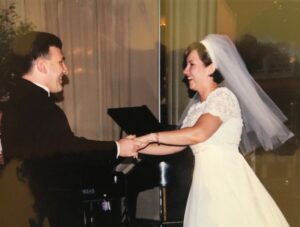
Before we got married we took dance lessons. From a local Arthur Murray studio. Private lessons because, at that time, there was no way in hell Dan was going to learn to dance in a group setting. Cassie loved the lessons. Dan hated them. And he didn’t hide it. Often he would “escape” to the bathroom for a break and Cassie would end up apologizing to the instructor for Dan’s grumpiness. The instructor, who was really good-natured through all of this, suggested we learn the basic dances – foxtrot, swing, waltz – over eight or so lessons. However, at our first lesson, Dan declared he only needed to learn one dance. The one that would best fit the song we had chosen for our first dance as a married couple. One dance only. In Dan’s mind, there was no reason to learn other dances when the sole purpose of these lessons was to get us prepped for the one big dance.

We share this because recently, at a socially distant dinner with friends in our backyard, we were discussing how families change when a kid goes off to college. One person said that when her oldest left it was “like the rest of the family had to learn a new dance.”  Before that, everyone knew their dance steps – their role in the family, But, when one family member was no longer home, they all had to adjust. Learn new steps, a new rhythm, a whole new dance. 

Cancer has forced us to learn a new dance. The music has changed at our house. We’ve each been required to take on different roles and to approach our lives differently — individually and as a couple.

Dan has become a caregiver. Cassie has become (or is trying to become!) a “caregetter.”  Cassie’s new moves include patience, asking for and accepting help (the accepting part is an exceedingly complex and difficult dance step). She has had to practice doing less and sharing more which, for an intensely private person, is like learning to dance without any music. Dan’s had to learn to notice and do more, read Cassie’s energy level and he too has had to practice asking for help and support from friends and family which for him is also not a natural move. New communications challenges have also emerged. Dan is learning (duh) that he can’t encourage Cassie to let him do more and then be resentful when she does. Cassie has had to work on not taking her anger at the cancer out on Dan. New moves abound.

So how do you learn new dances on the fly with no lessons? While we both have received valuable support in our new roles thanks to Firefly Sisterhood and Jack’s Caregiver Coalition, we are finding out that we mostly have to teach ourselves. Try on these new roles. Plan new activities and don’t abandon them right away if they feel a little awkward. Stumble through uncomfortable exchanges and conversations. As we navigate living with metastatic breast cancer, we are learning to dance all over again and this time it’s not just for one song — it’s for our entire lives.

Cancer. I’m against it.

By | Blog

Cancer. I’m against it. 

Today is the two year anniversary of my diagnosis and I am acutely aware of the impact metastatic breast cancer has had on my life. All that has been lost. All that has been taken away. All that is different. I’ve been encouraged by friends to be more open and explicitly share the challenges of living with MBC. So on this anniversary, I’m going to give it a try. This level of sharing doesn’t feel natural, but as Dan and my therapist say, it’s probably good for me.  

Cancer makes me feel less than myself. Simply put, I just don’t have the physical and emotional energy I used to have. 

My cancer scares those who love me.   

Cancer removes unadulterated joy. Things just aren’t as fun as they used to be. The cancer cloud hangs over everything. Sure, I can still have fun but things aren’t as light and carefree as they once were. 

Cancer has changed my relationships with my husband, friends and family. Dan and I have adopted different roles in our marriage. Friendships feel different with the overlay of cancer. People are more cautious and solicitous around me. Not all bad. Just very different.    

Cancer makes the future something I don’t look forward to. How could I? I know that this disease will likely kill me and I know the stories of how other women have died from this disease. It is scary, painful and sad. Imagining my life even three years from now is challenging.

Cancer negatively impacts holidays and special times. Even before a holiday or special event I find myself worrying about what feelings will come up for me. Will I get emotional? Will I compare this event to a similar event pre-cancer? Will this be the last time I get to do or experience something? 

Cancer prevents me from trusting my body. Every ache and pain causes alarm. Has the cancer spread? Or, is it just that I’m over 50? If I ignore a new pain am I being stupid and irresponsible? If I act on every new pain am I a hypochondriac? 

Nancy Stordahl (@nancyspoint), one of the bloggers I follow, wrote a memoir “Cancer Was Not a Gift and It Didn’t Make Me a Better Person” and I couldn’t agree more. The relentless nature of metastatic breast cancer is exhausting and all consuming. But, I am committed to living as fully as I can for as long I can. I have much to be grateful for in my life overall but today, on the second anniversary of my diagnosis, I am far more sad and mad about how my life has changed. 

Cancer. I’m against it.

Worrying About Worrying

By | Blog

Married couples worry about one another. That’s part of the deal. The person you love most in the world is often on your mind and you are on theirs. 

Before Cassie’s diagnosis you could probably best describe our mutual worrying as “situational” in nature. If one of us had a big meeting or deadline at work the other shared the anxiety. If either of us was feeling crappy the other’s sense of concern was evident. Cassie would worry about Dan’s possibly unhealthy attachment to the characters in Game of Thrones. Dan would worry about Cassie eating popcorn (and only popcorn) for dinner when he traveled. Worrying for each other was a part of our life but only a small part.

Not anymore.

Now Dan worries about Cassie all the time. The past weeks she has had far less energy than normal and there is nothing he can do other than worry. Her vision has recently become a little blurry — it’s probably eye related but it sparks massive worry about a brain metastasis. Cassie’s sad, Dan worries. Cassie cries, more worry. A fun upcoming event sparks worry about energy levels. After the event there are new worries about not having something to look forward to. Cassie’s friends not checking-in enough, that’s worrisome. Friends calling too often, a different worry (sorry friends you can’t win). How do we fill our time? That’s a big worry. What if something we planned doesn’t feel as joyful or fun as we expected? Now add in Coronavirus, greater isolation, Trump and open questions about whether we as a country will seize this movement moment on racism and it feels like worry, on top of worry, on top of worry.

And it’s not just Dan who worries. Cassie is constantly concerned about how much Dan is taking on. She worries that she is not doing her share and that he will grow resentful. Cassie worries when Dan is quieter than usual then worries more about whether to say something about it. Cassie worries constantly about what the future holds even as she recognizes we have little control over it. She worries about every new ache or pain and whether to call the doctor or wait and see. She worries about Dan’s mental state, sense of loneliness and how we can best stay connected. 

This isn’t situational worrying anymore it’s more like universal worrying and it can be suffocating. We are also pretty sure that this near constant and mutual worrying isn’t particularly healthy for our relationship. The other day after an emotional back and forth about what was worrying each of us, Cassie noted: “I can see why so many couples who go through this wind up getting divorced.” That’s not remotely our situation but it’s a relevant observation. A 2009 study published in the journal Cancer found that a married woman diagnosed with a serious disease is six times more likely to be divorced or separated than a man with a similar diagnosis. Among study participants, the divorce rate was 21 percent for seriously ill women and 3 percent for seriously ill men. The constant worrying, the need for even better communication, the changes in our roles and relationship and the unrelenting nature of it all. This shit is hard. 

We are trying to get better at interrupting the constant voices of worry that fill our heads without minimizing the challenges in our life. We are also trying to figure out how to better raise these topics with each other. It can be hard to hear each other’s fears and concerns without reacting defensively, especially when these have to do with how we are showing up. Dan can get angry when Cassie points out he has lower energy than usual and Cassie understandably can get really frustrated when she feels like Dan is judging her self-care. 

Navigating all of this worrying is really complicated. What we are learning is that like most everything else related to metastatic breast cancer, we need to be patient and gentle with each other. It seems like the goal isn’t to stop worrying (which would be impossible) but to try and not let worry consume our days. We also see that we need to better share the weight of our worries rather than each continuing to try and carry them alone. And on the up side, Game of Thrones isn’t on anymore and Dan isn’t traveling so no more popcorn dinners — it’s nice when at least some worries get resolved. 

Of Bumps and Earthquakes

By | Blog

We got back from California six weeks ago today.

It’s been a bumpy transition.

The drive home was scary with virtually no masks to be seen in the five states between California and Minnesota. We were greeted at home by a letter from Cassie’s oncologist notifying her that he was moving on from his primary practice. We had to figure out how to shelter-in-place here. We were scared we might have picked up the Coronavirus on the way home so we strictly self-quarantined for 14 days. After that, we had to work through all the decisions that our friends and family had already confronted while we were gone and living in relative isolation in California — who do we see, how do we see them, how to stay safe, how to shop, where to shop, does Cassie go out or only Dan, how do we get house repairs done in a safe manner, on and on. We didn’t always see eye to eye on these things so we had to talk them out again and again. At the same time, Dan’s work (which is supposed to be pretty limited right now) not surprisingly intensified as his clients confronted the ongoing reality of working through a pandemic. Our lives aren’t currently set up for Dan to work a lot so this added even more bumps.

And that was all before George Floyd was murdered. His tragic death isn’t a bump though. It’s an earthquake the magnitude of which none of us yet know. Our hearts broke at the injustice but we are trying to hold onto hope that the resulting tremors will shock and eventually topple the foundations of systemic racism that underpin our country. We’ve been trying to figure out how we can best fit into the “movement moment” that seems to be emerging at a point in our lives when our attention and energies are consumed by Cassie’s cancer. One thing that has occurred to us is that given our current life situation we are in a position to learn and speak about the racial disparities that exist in health care in general and cancer care in particular so we will do that at a minimum. 

The murder of George Floyd is the first thing in the last two years that has dramatically shifted our focus from Cassie’s diagnosis. Of course her illness is still there. This week in particular Cassie has felt like she’s been hit by a truck, drained, tired, wiped out — googling “why” she is feeling so exhausted (answer: she has late stage cancer and the medication she is on impacts her differently at different times) and hoping this doesn’t mean that anything has changed medically. At the same time, as we try to ease back into our Minnesota life and put the bumpy transition behind us, our passion for justice remains, our recognition of our own privilege is acute and we are committed to doing what we can given where we are right now. Metastatic Breast Cancer is such a big thing but it’s not the only thing. 

Uncertainty Meets Uncertainty

By | Blog

When we received Cassie’s Stage IV cancer diagnosis in July of 2018 the only thing we knew for certain was our lives would never be the same. 

Having late-stage cancer means your life is filled with uncertainty. What will a scan show? What will side effects of medications be? How long before the disease progresses? How long will Cassie live? Will our relationship survive the stress? How will our relationships with family and friends change? 

After almost two years of living with metastatic breast cancer, we have learned to manage that uncertainty just a little bit. As a couple, we’ve developed coping mechanisms and patterns to help us through. While we haven’t mastered the cancer uncertainty by any means, we have gotten more comfortable with it. 

Then along comes coronavirus.  Our already uncertain world is rocked with more uncertainty. What happens if one of us gets the virus? How do we stay as safe as possible? Can we see our family and our friends? How do we live our lives to the fullest in this crazy time?

Coronavirus has stripped away some of our traditional coping mechanisms like having dinner with friends, hosting our family at our home, going to a brewery or to a movie. The new uncertainties of the times coupled with the cancer uncertainty has rocked our world. Uncertainty has met uncertainty and it’s disorienting. 

We were in California when the first stay at home orders were issued. We remember being in disbelief. This is really serious! One on hand it was difficult to be so far from home and our support network during a pandemic. On the other hand, there were less choices we had to make. No friends or family to see, no restaurants to go to, fewer choices to make which was helpful so we just stayed home.

Now, back in Minnesota, we’re once again faced with lots of uncertainty. As our state opens up, there are so many more choices we’ll have to make and more choices means more uncertainty. It’s scary and once again we feel like we are in a period of transition into some new unknown phase. We imagine that like what happened with cancer, we’ll get better at living in the world of coronavirus uncertainty. But, we also know that it’s likely to take some time.