Caregivers Have Feelings Too

By | Blog

Last weekend Dan and I, along with my parents, attended the Midwest Metastatic Breast Cancer Conference. It was interesting and we learned a lot about medical research, clinical trials, palliative care, integrative health, and advocacy and got to connect with others living with MBC. Dan co-led a session on being a caregiver and that, combined with some thinking I was already doing, has me reflecting on the role of caregivers. 

The life of a caregiver is tough. Always putting the needs of the “care-getter” above their own. Sacrificing personal wants and needs for the other. And sometimes minimizing their own emotions and feelings of sadness about their loved one’s illness in order to keep a brave face.

As a care-getter with an amazing caregiver, I need to remember how hard this is for Dan. My cancer affects him deeply . . .And, he is allowed to show it. To others and to me. 

For the last couple of weeks, I’ve noticed Dan feeling more down than usual. He was going about his day-to-day life, but I sensed an unusually deep layer of sadness and discontent. Kind of one of those things that when I was healthy I’d wonder whether I’d done something to piss him off! But this time I heard the voice in my head saying: “Of course he is sad, his wife has a terminal illness.” Dan’s life has been turned upside down. Much of what we had hoped for and expected from our lives together is different now. 

It is interesting to experience how our relationship has changed since the early days of my diagnosis. Moving from “deal” mode, to settling into the ongoing reality that this is our life now. 

How do I as a care-getter support my caregiver? Can our roles ever switch back and forth? I’ve been trying to encourage Dan to do things that are fun for him and that don’t necessarily include me. However, he is often hesitant to do that because he wants to maximize our time together. But self-care for both of us is now more important than ever. How do I help him with his? Is there a way for us to have days where we step out of our caregiver/getter roles? Maybe not but perhaps we can redefine those roles to fit where we both are and what we both need right now. 
The Shallow End of the Swamp

By | Blog

It’s been roughly 15 months since Cassie was diagnosed. In that time, we have learned that one of the most challenging things is balancing conflicting realities. For example, on many if not most days, Cassie feels pretty crappy (not that you could tell by looking at her but that’s a whole other blog post). She’s got far less energy than she had before — a third less on a stellar day — her joints hurt and she often just feels what we have come to call “ooky.” It’s a pretty crummy way to have to live but it’s Cassie’s reality.

Another reality is that this period of time, right now, in the years immediately following diagnosis likely represent the best that Cassie will ever feel again. This is it. We are in the MBC “glory days.” On the top floor. In the rose garden of terminal diagnosis. This is as good as it will probably ever be and that’s a reality too.

So you put those two realities together and it can make your head spin. Cassie feels pretty crappy. This is the best that Cassie will ever feel. WTF? 

Dan was talking about this in therapy a while back and his therapist got it right away and said: “Yeah you are in the shallow end of the swamp.” That framing immediately resonated with both of us. We are most definitely in the swamp and the swamp sucks. There are metaphorical snakes and alligators and bugs and it’s hot and unpleasant. But in the shallow end you can still move around and occasionally find dry land. You can navigate and get some relief. For us, being in the shallow end of our cancer swamp means that’s Cassie side effects are pretty minimal. That she can still drink wine and travel and that we do a lot of the things we enjoy, even if we have to do them differently than before.

When we think about being in the shallow end of the swamp it’s not the same as saying that our glass is “half-full” (nothing about this glass is good). It is more about acknowledging that our  realities don’t have to be in tension. Both are true. We also have a choice. What are we going to focus on each day? The swamp and how shitty that is, or the fact that we are not yet in the deep? On good days we remind each other that we are in the shallow end and try to take advantage of it. It’s not easy but right now it’s the best we’ve got.

All Too Real and Surreal

By | Blog
  • Real. Re·al. Adjective: Actually existing as a thing or occurring in fact; not imagined. Real is used when a thing is what it appears to be. 
  • Surreal. Su·re·al. Adjective: Marked by the intense irrational reality of a dream. Also unbelievable. 

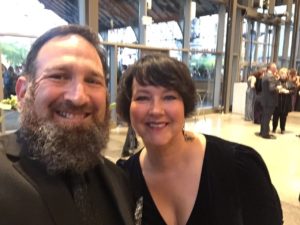
For both of us, last Saturday night was equal parts real and surreal. We were attending the second annual “Metsquerade” Ball sponsored by Metavivor — a nonprofit organization dedicated to increasing awareness of advanced breast cancer and equity in research. It was in downtown Minneapolis and we Ubered over thinking we might need a few glasses of wine to get through the evening. 

Now we have both been too a lot of fundraisers. Cassie is a nonprofit fundraising professional and Dan has helped raise money for many candidates and causes. We’ve hosted, sponsored, promoted, and attended more events than we can count but Saturday night was the first time that we’ve been to a fundraiser where one of us was the subject of the appeal.

Two times during the event, Cassie was called to the stage with the other “thrivers” who were in attendance. (MBC patients refer to themselves as thrivers not survivors because, for now at least, survival isn’t a possibility for this terminal disease.) The first time on stage, Cassie looked out at the packed room while a modern dance troupe performed and then each “thriver” was presented with a rose. The second time was for the In Memoriam section of the program which took place while the singing surgeon (yes that’s for real you can google him) sang “Rise Up” and images of those who have died filled the screen. It was all incredibly emotional, and as Cassie got back to our table with tears in her eyes, she said “I don’t like this one bit.”

The rest of the evening was equally emotional. We honored a ferocious local MBC advocate, heard from the volunteers who tirelessly organized the event and raised a significant amount of money for metastatic research. That last part is sorely needed as less than 5% of all money raised for breast cancer research goes to MBC even though 30% of women diagnosed with breast cancer will eventually see it metastasize. When we first learned of this disparity we were shocked and we now want to do our part to support organizations like Metavivor that are committed to narrowing the gap. As an aside, if you are interested in a first-hand account of this research disparity issue check out this local news story (https://youtu.be/TN7QfNcediA) featuring our friends (and Saturday night table hosts) Kim and Dustin Cesarek. 

As the event progressed, we were both overcome. It was impossible to ignore the fact that one day it will be Cassie’s image on the screen being remembered and that is as real as it gets. At the same time, it was all very surreal. We still have trouble believing that this is now our life and how much everything has changed. We sat there squeezing each other’s hands immersed in the reality of the moment but still feeling an intense sense of disbelief. Then we went home and had another glass of wine.  

Birthdays

By | Blog

Today I turn 52. Historically I have always loved my birthday. You can ask any of my friends and they’ll likely attest to my birthday zeal. I always looked forward to it, counted down the days, and usually planned multiple celebrations including the exact same birthday dinner year after year. This isn’t as self-absorbed as it probably sounds, as I also love other people’s birthdays. I think that all birthdays are special — warranting attention, love and gratitude.

This year though, as my birthday arrives, I am overcome with ambivalence. On the one hand, I am looking forward to spending the day with Cassie and seeing friends and family this weekend. On the other hand, I no longer want to mark the passage of time. Nor do I welcome the sense that the years seem to be speeding up. Since Cassie’s diagnosis, I feel like our relationship with time is changing. I want the years to move slower not faster. If we really only have limited years left I don’t want to acknowledge another one passing. I feel that with my birthday I can hear a giant clock ticking faster and louder and I want to cover my ears.

When Cassie and I were talking about this at breakfast yesterday, she said: “I guess birthdays are like everything else now — they’re different.” That seems right. We are living in a new normal and nothing is exempt not even birthdays or holidays (New Year’s Eve is another tough one when it comes to marking time). We still feel joy but it’s often more muted. We still celebrate but with a different lens. We still embrace gratitude but also accept what we have lost as our life has changed. We know we can’t stop time but we want to slow it down, day-by-day, as much as we can. 

This year, as I blow out the candles on the giant birthday cake that I always share with my niece Sylvia I won’t be wishing for the Cubs to win the World Series in 2020. I’ll be looking at Cassie and wishing for more time.  

Utter Lucidity

By | Blog

Right after the diagnosis, Cassie started looking for resources online to learn more about metastatic breast cancer and to learn from the experience of others. She started following roughly six bloggers on a regular basis. (Three of those women have recently died. Such is MBC.)

On one of the blogs Cassie follows, we came across this quote: 

“Oncoming death is terrible enough, but worse still, is oncoming death with time to spare, time in which all the happiness that was yours and all the happiness that might have been yours becomes clear to you. You see with utter lucidity all that you are losing.” — Yann Martel, Life of Pi

Every time we read this we cry. Every time. But, we wanted to share it because it really sums up what we are going through. 

We are so grateful that we still have time together to try and enjoy life (many people with late stage cancer wind up with little to no time). Yet metastatic breast cancer is a lonely road. You can look fine on the outside but feel crappy on the inside. It can seem like life is normal when it is anything but. It is hard for people to understand. This isn’t – go through treatment and you’ll be cured. It is ongoing. Relentless. You are always living with the knowledge that unless you get hit by a bus or something crazy, that this is what will kill you. You don’t know when exactly (although 75% of those with MBC don’t live beyond 5 years.) But it’s coming. 

Everyday it’s a challenge to stay positive. Our mental frame is something we work on together from the moment we wake up. It’s difficult not to focus on all that we are losing. It’s difficult to avoid asking ourselves — every time we do something fun — whether this could this be the last time? It’s difficult to explain to our friends and family what this is like day-after-day because we only see them episodically and because we don’t want talk of cancer to dominate every interaction.

The one thing that makes any of this tolerable is that we also have utter lucidity about what matters most right now. We know we want to spend our time with each other and with friends and family. We know we need to practice self-care and we know that we need to match the relentlessness of the cancer with our own relentless and sustaining love. In this way, the clarity of what we are facing is both a daily burden and a blessing as it helps reveal and keep us grounded in the things that matter most.


Being Not Doing

By | Blog

One of the most challenging things about this diagnosis is the lack of control and lack of structure it has brought to our lives. How do we make sure that we own each day and create some structure for ourselves while also recognizing that Cassie has many days where low energy levels require her to do less? How do we learn to be okay with days that are filled with less doing and more being?

It’s strange to ever write the word lucky in relation to a late stage cancer diagnosis but we both feel lucky that we have been able to step away from our jobs. Cassie is not working at all and Dan has cut back by around 90%. However, without full-time work to occupy our days, we find ourselves making it up as we go along. Some days we have the energy to do a lot and keep a pretty full schedule. We exercise, see friends for lunch, work on a house project, go to a movie, etc. Other days taking a shower is about all we accomplish. (Some days not even a shower!) We are realizing that we have to be OK when we are not actively out doing things even though we are both doers and are both used to active and busy lives outside of our home. Learning to just be is new and hard but also grounding, liberating in some ways, and absolutely essential given our current situation.

This is made all the more difficult by the fact that we both almost always wake up feeling sad and like our lives have gotten really small revolving around the cancer. Fortunately, along with this morning sadness, we both have the most energy early in the day and we now know that we often have to deliberately focus this energy on re-centering and re-framing for the day ahead.

We’re coming to learn that each day (whether a doing-day, or being-day) is best with a little structure and intentionality. We try to have regular scheduling meetings to talk through the week ahead and the weeks to come. We have designated our mornings “self” (thanks Browns) where we each schedule whatever we want. For our afternoons and evenings, we try to plan something from at least one of our “buckets” and we try to have a couple of fun hanging-out “projects” in our back-pocket. For example, we recently completed watching every movie in the Marvel Cinematic Universe in story (not release) order.  On being-days, even just naming that we are going to stay in and read or do a crossword puzzle is helpful. Maintaining this level of intentionality about our days though is much easier said than done.

One particular challenge is that we don’t know in advance whether it will be a doing-day or being-day as this depends on how Cassie is feeling and her energy level. So ideally we would have two plans for each day but instead we are lowering the bar and just trying to take the being or doing as it presents itself. Within all this uncertainty, one thing we know for sure is that for us, every day is better when it includes multiple things that keep us connected as a couple. This could be a dog walk or a game of cribbage or entertaining friends. We have learned the hard way that unless we focus explicitly on connection we can easily drift into just doing our own things. And for us, right now in particular, living parallel lives simply does not work! Whether doing or being, togetherness is key. 

Asking for Help

By | Blog

So we are both oldest children. When you look up characteristics of firstborns you often see things like independent, assertive, controlling (bossy?), self-sufficient and more of the like. Throughout our marriage, we have somehow successfully navigated having these common traits even though we both usually think we are right. It’s probably worked because deep down we both know that being right and/or keeping score doesn’t really matter and simply doesn’t work when it comes to being married. 

So high amongst our shared characteristics is that we hate asking for help. We like to be self sufficient, keep our own counsel and muscle through tough spots on our own or by leaning on each other. We love helping others and are grateful when friends and family ask for what they need. But, we can both be pretty stubborn (just ask our siblings) and self-reliant to a fault.

This diagnosis has forced us to start changing our ways and we are finding it really hard. Cassie  can still do and wants to do most things but her energy level has decreased (on a good day it’s probably 30% less than before). Conversely, Dan has a lot of energy and wishes he could transfer it to Cassie but it doesn’t work that way. So every task is weighed against other tasks, activities and uses of our time. We can still do a lot but at what cost? Is plowing through our to-do list as we have always done the best use of time and energy? Which projects really matter? What fun do we wind up sacrificing in an evening because we insisted on muscling through in the morning? Can we let go of some things or, god forbid, can we imagine not doing everything or not doing it all ourselves? 

We are incredibly blessed to have a support network of family and friends who are willing to help us — who ask us continuously what they can do. We, on the other-hand, are not so good at taking our community up on these offers. Part of that is because, even though we are living in a “new normal,” we want our life to remain as normal as possible for as long as possible. This might mean cooking for ourselves (which Dan enjoys) or continuing to walk Doc which is so grounding (at least when it’s not 30 below). But this desire for normalcy isn’t the main reason we don’t ask for or accept more help — we’ve come to realize that we don’t do it because we aren’t that good at it. Period. 

We are working on evolving though and we are working on it together. We have to remind each other constantly that it’s ok to ask for help and we often switch roles in terms of which one of us is encouraging the other. We are practicing too. We tried a meal train for a few weeks last fall and while it felt awkward at times it also made life SO much easier during a particularly busy stretch where Dan had some big projects for work. We had a group of friends tackle all our yard projects in a single day this spring and that was so generous and helpful and provided us with an incredible sense of relief.

We are practicing now because we know that we are likely going to need a lot more help down the road. However, when it comes to asking for help we are pretty sure that for us, practice won’t ever make perfect. As typical firstborns, we will probably always try to retain some semblance of control. That said, we are learning all the time that this is one situation where self sufficiency isn’t sufficient. 


The MBC Roller Coaster

By | Blog

Spoiler Alert: This story has a happy ending.

So about two weeks after Dan’s mom died we got some potentially scary news about Cassie’s health. She’d just had a routine doctor’s appointment. So routine that she hadn’t even wanted Dan to attend (a first). No scans. No test results. Just some blood work and a short visit with the doctor. Purely routine.

Then they called. Cassie’s blood work had come back. Her kidney counts were way off — her creatinine levels were elevated much higher than they should have been. They told her not to panic (thanks) and that it might just be that Cassie was dehydrated at the time of the tests. They instructed her to drink a lot of water, lay off Ibuprofen and come back in a week to be re-tested. 

Left unsaid was that it might not be alright. That this might be the start of something new. Something bad. That maybe we should panic. The internet is not your friend at times like this. You know there’s that joke that if you look up an illness online you are always “three clicks from death.” Well that’s not as funny when you have metastatic breast cancer. When Cassie googled high kidney counts and MBC much of what came back was really scary. Some people do develop kidney trouble — not good. Sometimes that’s caused by the meds — also not good because we want to stay on these meds as long as possible. 

We started joking darkly about kidney failure. Visions of dialysis ran through our heads. It was too much, but what could we do? Cassie started a “water project” of at least 64 oz daily. She avoided intense workouts and rested more. We also told a lot of people because we were scared and this was our current reality.

And then everything was fine. We went back to the doctor (together this time). They did the test and asked us to stay for the results. We sat anxiously in the waiting room and then Cassie’s nurse came out and gave us the all clear. Probably just dehydrated she said. Keep drinking water. Nothing to look at here.

Whew, what a relief. But also what a ride. A true roller coaster of a week and certainly not the last one by a long shot. That got us thinking how do we handle these rides? How do we react but not over-react? How much do we share, when and with whom? We don’t want to shut out our family and friends but we also don’t want to scare them unnecessarily. Also how do we incorporate these regular ups and downs into our life as a couple? One of the things that is becoming increasingly clear to both of us is that as much as we ever thought we were “in control” of our lives before, we certainly aren’t any more. In so many ways, the MBC roller coaster is in control and we are just along for the ride. That doesn’t mean we don’t have lots we still get to decide on a daily basis, but it does mean that almost all of the big things are out of our hands. Makes us think a lot about the illusion of control we were operating under before. 

We are realizing (as with so much of this whole journey) that how we handle things will likely vary on a  case-by-case basis and that the bigger thing is to try and emotionally prepare ourselves for the constant ups and downs. That’s just part of our new reality which is too bad because Cassie really hates roller coasters.

How are you?

By | Blog

Having cancer is stressful. Not just the physical aspect, but the emotional and social aspects, too. 

Every party or outing we go to we think about who else will be there. Do they know our situation? How much or how little? Do we share the diagnosis or not? Do we have the energy for the “talk?” Mostly though we try to prepare for the inevitable question: “How are you?” 

Given how often this comes up and our professional backgrounds we have talked about developing our own cancer “elevator speech” (we have heard from others in our situation that they have done that) but haven’t done it yet because it’s actually pretty challenging. How do we best communicate how hard living with metastatic breast cancer is but also that we are doing as well as we can? We have shitty days. We cry. We question. We stay in bed with the covers over our heads. But, we also laugh, enjoy each other and our friends and family, take on new adventures and think about what new restaurants we want to try next.   

We’re finding how these conversations go just depends. It depends on how well we know the person and what we know they know about where we are in life. Cassie’s desire to tell every single person (like the person who owns the boutique she likes, the yoga instructor, and the manager at a restaurant we love) has subsided as the disease has become a more regular part of our lives instead of this piece of shocking news. But there is the question of authenticity. How can we best genuinely share where and how we are without taking every conversation down a long dark path? 

For us, we think about “how we are doing” on both a large or more macro scale and on a smaller or day-to-day scale. On the macro scale we are heartbroken, terrified, overwhelmed and incredibly sad almost all of the time. On the smaller, more day-to-day scale, we are often okay – which might mean we’ve slept well, gotten a workout in, are experiencing limited physical side effects and are looking forward to tomorrow. Another day we might be really struggling – haven’t slept well, experiencing side effects from the medication, and are feeling very emotional and like our lives are stuck or too small. We can have good days and bad days within the larger ugly context of metastatic breast cancer. We can be both okay and not okay at the same time depending on the scale or lens we are using to answer the question.

Another part of this is that we are learning about the importance of regularly checking in with each other on the related question of “how we are doing.” As a couple. Are we connected? Are we focusing enough on our buckets? Are we helping each other slow down? Are we in sync? This requires a degree of intentionality that we both find enormously challenging but that we are coming to realize more and more is absolutely essential. We can both be doing all right as individuals but not as well as a couple so we have to ask and answer the question both ways.

After losing her husband, Sheryl Sandberg talked about how jarring she found it when people asked how she was doing. She suggests re-framing the question from “How are you?” to “How are you today?” While we can’t, and really don’t want to, have a say over what people ask us, we can take control over how we answer the question. Today, we are okay.

One Year

By | Blog

The one year anniversary of Cassie’s MBC diagnosis is today, July 13. In some ways, we can’t believe a year has gone by. In other ways, we can’t believe it’s only been a year.

Reflecting on the past year is difficult. We still cry every time we start to think about where we’ve been, what we’ve lost and what is ahead. So we’re keeping this post simple. To mark July 13 and this anniversary (cancerversary) that we wish we didn’t have to acknowledge, here are 13 things we’ve learned over the last year.

13. It’s best to have difficult conversations at a brewery.

12. More than one night apart from each other is too many.

11. MBC is relentless. 

10. Slowing down and being intentional about every day is super hard for us.

9. MBC research is underfunded. Less than 10% of all money raised in support of breast cancer research goes toward a cure for metastatic breast cancer. 

8. How we see ourselves in the world is changing. 

7. Cassie can nap. Really.

6. A good therapist is key.

5. As shitty as this all is, we are so grateful to have good insurance, great care and flexibility with work because so many people don’t.

4. Our support network is deep and wide.

3. We’ve got to be patient with each other.

2. We can be okay and not okay at the same time.

1. Our love is very strong