Last Time. Last Time?

By | Blog

The first time we visited Napa was in 2006. It was a 60th birthday present for Cassie’s mom and for us and Cassie’s parents it was the trip of a lifetime. It has also become our (and especially Cassie’s) happy place. We’ve been back almost every year since — sometimes more than once a year — and this spring represented our third extended stay in the valley. 

We love it here. The food. The wine. The pace. The history. The mountains. The people. The small towns. The breakfast burritos. The scenery. All of it. And we know how lucky and privileged we are to get to spend so much time here and we don’t, for a second, take that for granted. 

For us, like everybody else, the last ten weeks were not what we expected. We had big ambitions for our Napa time with lots of visitors and activities planned. After our first ten days that all changed, and we discovered that we could easily slip into one of two unhelpful mindsets. We could compare this time to our last time(s) here and bemoan how different it is. Alternatively, we could become obsessed with the fact that this might be our last time here given Cassie’s metastatic breast cancer diagnosis. Who knows how she will feel a year from now. What if we never come back? What if this is our last time? 

Last time. Last time? Twin traps. One rooted in past comparisons. The other in future fears. The challenge we found is to stay rooted in this time because it actually is the only thing we get to control. And that’s not just about this ten weeks in California — it’s relevant to every aspect of our lives now. Are we going to spend our remaining and possibly severely limited time together wistfully looking back or in constant fear of what is to come or can we try to stay connected to each other and to each day? Honestly this is super hard for us but we have found that usually one of us at a time can stay more rooted in the now and help the other get there. We do that for each other constantly and it’s helping make this time, right now, some of the richest most connected time of our twenty-eight year relationship.  
Hope IS a Strategy

By | Blog

I don’t know the first time I heard the expression “Hope isn’t a strategy” but I have certainly quoted it a number of times over the years. Usually it is something I’ve said to a client or a campaign I was advising as a way to make the case that we needed a plan or a more focused set of goals, priorities and tactics. It would usually engender a laugh and was a good way to provoke discussion. 

Last week though, I found myself saying the exact opposite. I was talking to some fellow cancer-caregivers and we were all discussing how scared, anxious and overwhelmed we were by the current situation. Now not only do our spouses/partners have cancer but they are also at heightened risk of getting Covid-19 and while that is scary for everyone it is especially frightening for those who already have severely compromised immune systems.

So we talked about our fears and all the plans in our lives that have changed. The fear of even stepping into a store because it might result in infection and god-forbid an even earlier death of our loved one. The “bucket-list” trips that people are cancelling without knowing if they will ever get to take them. The sadness and loneliness of not being able to accompany our partners to the doctor. How do you process all of this? How do you not have it overwhelm you?

That’s when I found myself saying: “Maybe hope is a strategy.” It immediately rang true because for me and others in this situation it is actually the only thing we have. Cassie was feeling awful the other day (almost couldn’t get out of bed) and really the only thing I could do was hope that she would feel better the next day. I hope all of the time that new medicines will be discovered. I hope that we have more time together. I’m encouraging us to make future plans and hope we can follow-through on them. I hope that I won’t wake up crushingly sad, or if I do, that I can hopefully find something that day to put a smile on my face. 

And now, in the middle of this new scary pandemic, I am finding that for me hope is more important than ever. There is so much fear, so much I am angry about. So many injustices and so many unknowns. The only way I can handle it all is through the hope of better days ahead. Hope that we will learn from this and act accordingly. Hope that suffering will be less than predicted. 

So I guess hope can be a strategy and I’m embracing it as I face both cancer and Coronavirus.

Decision Making with Cancer

By | Blog

When Coronavirus hit California (where we are spending this spring) Dan wanted to come home. Cassie didn’t. 

Dan was scared being so far from home, our support network and Cassie’s doctors. He worried incessantly about what would happen if one of us, especially Cassie, got really sick. More than anything else he feared her being in a hospital and possible dying alone.

Cassie on the other hand actually felt more relaxed than she had at any point since her diagnosis. Napa is her happy place. She was sleeping better, walking more and, as she pointed out it’s not like we would be seeing people if we were home. She has spent a lot of time contemplating her own mortality since her metastatic breast cancer diagnosis which probably explains why her fear was less pronounced than Dan’s.

So do we leave or do we stay?  Does Dan get what he wants or does Cassie? That was our conundrum in early March.

We decided to give it a few days on the well-learned theory of not making major decisions impulsively (been there, done that). Yet we remained at loggerheads. Dan grew even more anxious. Cassie more settled. 

How to decide?

Like all long-married couples we’ve had our share of disagreements and we’ve learned how to work through them. We can usually find a compromise or talking it out leads to one of us changing our minds or deciding that whatever it is actually doesn’t matter that much to them. 

Then Cassie got sick and her diagnosis has complicated our decision-making process. Dan’s initial tendency post-diagnosis was to just agree or cede to Cassie’s wishes/opinions but that turned out not to be such a good idea because it drove her nuts! Cassie doesn’t want every decision to revolve around her or her situation. She doesn’t want the pressure of always having to be the decider or the sense that everyone (Dan, family, friends) is constantly deferring to her wishes. She doesn’t always want to be on the spot for making a choice or offering her opinion first. She craves a return to some sort of normalcy in our life including how decisions get made.  And of course this all makes sense. It’s not good for our relationship for Cassie’s opinion to always dominate so we need to find better ways of balancing her cancer and our decisions.

This played out in real time with some friends recently (pre-stay at home order) when we had a full day planned and had to decide whether to curtail it some. We all instinctively turned to Cassie and asked her what she wanted to do? But she helped guide us through an alternative approach. She gently said “I don’t want this to be all about me so why don’t we all share what we are thinking and then we can decide.” So we did and we did. It was still pretty stilted because once the idea of stopping sooner or resting more is “out there” it can easily take on a life of its own but we still tried to come to a decision as a group without either automatically deferring to Cassie or centering her situation above all else. For Dan it was a valuable lesson in navigating choices with cancer and trying to keep decision-making as normal as possible.

It isn’t easy because even while craving a return to normalcy in our lives we both recognize that nothing will ever be normal again. Cassie does have metastatic breast cancer — full stop. Everything has changed. And that was before Coronavius hit. Now “normal” feels even more like a mirage. We are all going to have to adjust to a new normal and that includes figuring out how to make decisions through the lens of both MBC and an ongoing pandemic.

For us, that has meant trying to distinguish between big decisions and the many more routine choices that we have to make all the time. A potential (maybe obvious?) guideline that we are now playing with is: The bigger the decision the more it’s informed by Cassie’s cancer. The converse is also true. So for the countless daily, weekly or social decisions that arise we will attempt to treat them as “normally” as possible without centering Cassie’s diagnosis. But for bigger decisions it will be more of a factor.

That’s how we ultimately decided to stay in California. One of us was going to be disappointed by the decision. If we picked up and went home it would be Cassie. If we stayed – Dan. In this case, because we were already here and because we don’t know how Cassie’s illness will progress or whether we will ever make it back we decided to stay. Looking at it through that lens felt right for both of us and Dan has actually been able to let go of a lot of his anxiety simply by seeing how much being here means to Cassie. It was a good choice and it taught us a lot about the challenges of making decisions with cancer. 


Time in the Age of Coronavirus

By | Blog

Since we’ve been in quarantine we’ve started to exercise at home. We walk a lot — so much that Doc the Basset Hound frequently stops, lies down on the sidewalk and glares at us. We’ve also been using the Peloton app. We had previously thought it was just for biking but we discovered that you can do cardio, body-weight strength classes, yoga and even meditation (though we haven’t advanced past five minutes for those yet). 

In the middle of one recent class, our instructor, with an eye towards motivation, exclaimed something like: “Make the most of this moment because you can’t get it back — time is NOT a renewable resource.” That throw away comment struck us both in the moment and we’ve returned to it often since.

Time is not a renewable resource. So simple and yet kinda profound. Upon reflection, we both think that until Cassie got sick we had often treated time like it was renewable. Sure we tried to be intentional (and were getting more so as we got older) but often days and weeks would just fly by without our giving real thought to what we were doing and why. We would often over schedule ourselves and become more focused on getting everything done than enjoying what we were doing. Occasionally we would realize how fast we were moving or how busy we were and try to re-calibrate. Mostly though we just kept going because we just assumed we had enough time to do everything we wanted. If we were too busy this week we’d do it next week. If we didn’t get to it this year there was always next year.

Then Cassie was diagnosed with metastatic breast cancer. While it varies greatly by person, the five year survival rate is just 22%. Less than a quarter of people with this disease will live beyond five years post diagnosis. Even with all of our doctor’s caveats, that statistic slapped us in the face. It also changed how we started thinking about time — it really is precious or in the words of our Peloton instructor it’s nonrenewable. We identified a set of personal “buckets” to help us focus and prioritize our time (for more on what those are, see our 3/21/19 blog post) and we are making different choices than we were before. Our relationship with time has changed. 

And now along comes Coronavirus and once again life as we (and everybody) know it has changed. One day bleeds into the other. Weekends mean less. Time feels different. And Cassie in particular can’t help thinking about the fact that she only has limited time left and some (much?) of that is likely going to be spent in isolation not doing the things we had planned. Not seeing the people we love.  Not taking advantage of the energy she has now but won’t have later. What if this is the last time we ever get to come to Napa (our happy place) and we just spent most of it indoors?  What if we don’t get to see our friends and families for months? What if Cassie begins to decline next year and this, her last “good” year, was largely spent in isolation? These are impossible questions with no real answers but this week they’ve resulted in a lot of tears and a lot more thinking about how we maximize our time no matter the circumstance.  Can we stop thinking about this as lost time and somehow re-frame it as found time for the two of us as a couple? That still feels hard but probably worth trying. 

Oh yeah and we are also setting a strict daily step limit for Doc so he stops glaring at us. How he uses his time matters too. 

Warning: Coyotes Ahead

By | Blog

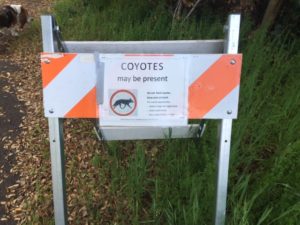
Neither of us are all that into Astrology but that doesn’t mean we aren’t open to signs. Everyday we encounter signs. But, do we follow them or decide to ignore what they tell us? Doc and Cassie recently stumbled on this sign during a walk.

They heeded the warning and turned around.

Living with a terminal cancer diagnosis and being their caregiver both require expert “sign-reading” skills. For the care-getter: How do my actions translate into how I feel physically? How does the way I feel today compare to previous days/months? What things make me more emotionally healthy? For the caregiver it’s heeding signs about self-care even as you worry more about your partner. It’s also being constantly aware of how your loved one is feeling and when to offer your thoughts and opinions about their life, actions and decisions — these are especially tricky signs to read.

In this time of staying at home and living life much differently than we used to (even after the cancer diagnosis), we are both seeing signs. For the most part, Cassie is feeling well — some days even than when we were home. We’re taking this as a sign that a slower, more relaxed pace is beneficial. Cassie’s joints hurt less. This sign points to the benefits of single level living and lots of walks. She’s also sleeping better. Maybe the dog is not allowed to sleep with us when we get home? And despite the worry about Covid-19, she is feeling less stressed generally — we’re not sure what this sign is! 

For Dan less social media and news has resulted in far less anxiety (maybe that stays). Truly limiting work to dedicated days/hours has resulted in greater presence at non-work times (can he continue this discipline?)

What part of this slower, pared down life works for us? Are there things from this time that we want to carry forward after the quarantine is lifted? Is it possible for us to move out of quarantine time and continue to have fewer expectations for ourselves? Can we move forward with a priority on taking walks, napping, reading and playing cards? 

How do we read these signs and apply the messages moving forward? 

PS: Here some other signs we’ve recently seen and appreciated.

PPS: Cassie is a Taurus and Dan a Libra, in case you’re curious. 

Look Up

By | Blog

I look down a lot – not on other people but when I’m walking. Did the dog poop? Is there a crack in the sidewalk? (I do have a propensity to fall so that one kinda makes sense.) Is there a stray sandwich on the ground that Doc could get? 

The other day, Doc and I were out walking our new route (in St. Helena California where we are spending the spring) when he decided to stop. He just sat down and there was no moving him. So, being that we had no particular schedule restraints I just let him be. In that moment I looked up and saw the most amazing view of sunshine and fog on the mountain side. It was incredible. Doc and I had walked this same route at least twice before and I had never noticed it. Too much looking down. What other things had I been missing? 

What I realized is that when you slow down and look up you can see some cool stuff. A street bearing the same name as a friend. Two stone bears a top pillars flanking a driveway. A tree in bloom. The moon. 

I find myself continually amazed at how interesting and beautiful the world is. I like to think I was pretty mindful even before my diagnosis but I’m still surprised by the things I miss. For me, I think, it’s about remembering to be in THIS moment.  This is especially true in the midst of all of the Coronavirus fear. Right now it’s even easier to look down both literally and figuratively and instead I want to keep reminding myself to look up. Right now, today. Observing and taking each moment one moment at a time. Who knows what I’ll see today and how it will make me feel? This type of attention and intention grounds me, gives me focus and instant gratification.  

So, on this scary cancer journey and in these days of Coronavirus I commit to looking up AND walking safely! 

Social Distancing From the News

By | Blog

When Cassie was first diagnosed with metastatic breast cancer 19 months ago our lives were turned upside down. We were scared and overwhelmed. We didn’t know what to do or where to turn. We woke up anxious and went to bed the same way. We didn’t sleep. Our normal routines were upended. We were consumed by fear and uncertainty. Sound familiar?

Everything that we felt then has come rushing back these past weeks. It has reminded us that one of the first things we did when Cassie was diagnosed was to try to reduce other things that were causing anxiety in our lives. Primary among those was the daily onslaught of news and (for Dan) social media. We have both always been avid consumers of current events — reading multiple papers daily, staying engaged and using our I-pads and phones to check the news throughout the day. 

After we found out that Cassie was sick we pulled way back. Dan got off social media altogether, we limited our news consumption to once a day and we focused on connecting with each other and trying to address the new and extreme anxiety that cancer had brought into our lives. Being less obsessive with following and tracking the news helped — a lot.  We settled into our new normal and while we remain engaged with external events it was to a far lesser degree than we had previously.

As the months progressed, we resumed our historic patterns but then Coronavirus hit. Given Cassie’s compromised immune system and being far away from our support system, we’ve both been filled with extreme anxiety (Dan more than Cassie, actually.) So we decided to again limit our news consumption to once a day. That allows us to still track what’s going on but to otherwise disconnect from seeing the same scary news over and over again.  “Breaking” news isn’t really breaking all that much anymore. Instead it’s the same information repackaged across different sites and under different headlines. We can easily learn what we need by checking once a day and use our found time to focus on things that are less anxiety producing whether that’s taking a walk, a new book, TV series or a game. 

To be clear, disconnecting from the news wasn’t easy for us nineteen months ago and it’s not easy now. We have to (gently) remind each other constantly. But, desperate times call for desperate measures and we hope that social distancing from the news will flatten our anxiety curve.

Keeping Spirits Up

By | Blog

Even before Coronavirus hit and many of us started “sheltering in place,” we had been struggling on and off with a sense of isolation. Since Cassie’s diagnosis, our life and routines have changed so much that we’ve had to consistently pay attention to our emotional health and sense of connectedness. 

We’ve learned (and are still learning) that keeping spirits up in a time of isolation and fear can be challenging. At the same time, we need to do our best not to spiral and succumb to feelings of loneliness, sadness and lack of purpose.

Here’s how we are trying to manage in the face of even greater isolation right now.

Focus on gratitude – even in the midst of this current pandemic crisis, we’ve got much to be thankful for. Safe shelter, plenty of food, access to good healthcare, ability to work less, just to name a few. So many others are facing huge obstacles. That leads us to thinking about…

Leaning into generosity – how can we help those who need help? We are donating to organizations on the front lines. We are buying restaurant gift certificates. We are responding to friend’s fundraising appeals for organizations they support. Supporting others is a good way to get out of our own heads and stay connected.

Connect with friends and family – one benefit of technology and being constantly connected is that although you can’t be with friends in person you can call, text, facetime, zoom, etc. It’s a blessing. We’ve both got a couple of virtual happy hours planned and all of our nieces and nephews should be watching their mailboxes for some help with the quarantine blues.

Exercise – Dan joined a health club here and it is still open but that doesn’t seem right. (No amount of bleach wipes can make that safe.) So, we’re opting to walk and walk and walk. It’s not even early afternoon and Dan has exceeded 10,000 steps. (Cassie will get hers later!) Doc loves these long walks.

Do projects – if we were home Cassie would be cleaning closets, scrubbing floors and emptying cupboards. But, since we’re in a rental house there is less of this to do. So, we are going to try to finish our death plans (both of us). Lots of letter writing is also in our immediate future. And, we’re posting a daily picture on Dan’s instagram page because not all projects have to be big ones!

Build in time together – Even though we are together almost constantly (here and at home), we’re still often doing our own things. Reading, Dan working, on calls with friends, etc. So, we wanted to build in some mandatory connecting time. We’ve decided to make it our mission to attempt the New York Times crossword puzzle each day. And, we’re committed to making our way through the 100 best movies of all time as named by the American Film Institute (https://www.afi.com/afis-100-years-100-movies-10th-anniversary-edition/). We just watched Guess Who’s Coming to Dinner last night. We’d highly recommend it.

Isolation is lonely. The unknown is scary. Our spirits can easily sag. All of that is natural but we are learning that creativity, invention and silliness can become natural too if we focus on them.  If there are things you are doing to keep your spirits up we’d love to hear! Please share in the comments.

Anxiety of the Moment

By | Blog

Last night Dan snapped at Cassie out of the blue and she responded with her own snappy retort. Our “snappiness” didn’t last long and it didn’t take Einstein to figure out that it had nothing to do with Dan’s particular comment. Rather we were both anxious and stressed out (like everybody ) due to Coronavirus.

Yes we are trying to “fear less” but how do we do that when, for the first time ever, one of us is in the special category (immuno-compromised people) that is being discussed on the news every minute? How do we fear less when we feel isolated being away from our friends and family? How do we fear less when we think about Cassie possibly getting sick 2,100 miles away from her doctors?

Do we stay here? Do we go home? We were already anxious before and now it feels like anxiety on steroids. 

Yet, at the same time, we don’t want to just give up on this time away. In many ways, since Cassie’s diagnosis, we have felt that one of the only things keeping us going is having stuff to look forward to and we’ve been anticipating this trip for well over a year. So while using common sense, we don’t want our fear and anxiety to rule us, to control our decisions. We don’t want to act precipitously or make a decision that we might regret when we have more information or a little time has passed.

On the one hand maybe going home makes sense. On the other hand, Cassie’s doctor didn’t say that and in fact said it was just fine to stay as long as we took precautions. And, if are going to have to “socially isolate” wherever we are, why not do it where its 70 degrees and sunny. Why not enjoy the delicious wine we have stock-piled and the fresh food that’s still available? Why not walk Doc among the vines (no people there), play a lot of cribbage in the backyard and enjoy each other’s company and focused attention?

There’s no clear-cut answer but we’ve decided to take it day-by-day and not let anxiety make the decision for us. That’s helpful in this moment and we have a feeling will also be a lesson that applies over and over again on this metastatic breast cancer journey.

Nights Apart

By | Blog

Cassie is the driver in our family. Everybody knows this. And it’s not just because she really likes to drive — which she does — it’s also because Dan is a lousy driver. Everybody knows that too. It’s not all his fault though as he comes by it naturally. Both of Dan’s parents made driving an adventure and neither of his brothers is an automotive rock star. So Cassie has always been the primary driver in the relationship.

This is significant because we decided to spend ten weeks in Northern California again this spring and we have historically driven out so that Doc the Basset Hound can join us and so we can have our car while we are there. This year, however, we decided it didn’t make sense for Cassie to do the drive given her varying energy levels. So Dan drove out with one of our close friends who graciously volunteered to make the trip. More accurately, our friend drove and Dan handled podcasts, snacks, and restaurant selections.  

It was a great road trip for them covering four nights and five days. The weather was perfect. The scenery beautiful. The podcasts funny. (Who knew true crime could be funny?) Yet it also represented the longest we have been apart since we learned that Cassie has metastatic breast cancer. Even though it was only four nights, we missed each other. We were both lonely and a little out of sorts. Dan was worried about Cassie. Cassie found it strange being in the house  without Dan or Doc. Dan didn’t sleep well because he kept rolling over, seeing an empty bed, and contemplating his future. 

It got us both thinking. How do we decide whether or not to spend time apart? We’ve both always been fiercely independent. Before the diagnosis we both traveled a lot for work, took  trips on our own and spent weekends away with friends. Sometimes we’d even make plans without consulting each other because it felt like we had all of the time in the world and both wanted the other to have fun. Now it all seems different. Every night away from each other feels like a lost night. Yet we still have things we want to do on our own and people we want to spend time with individually. So how do we decide? 

Sometimes it’s clear as it was with the California trip — the ends (ten weeks in California together and quality road-trip time with a close friend) clearly justified the means (five days apart). In other circumstances though, we’ve found we need to intentionally consider a set of questions before making plans. Will the time away from each other be restorative and energizing? How is Cassie feeling? How connected are we as a couple at that moment?  When were we last apart? How many nights are we talking about? 

There’s no clear formula but we’re realizing that time together is more precious than ever and sleeping next to each other can no longer be taken for granted.